NVIDIA is packaging the major parts of a conversational game character into an on-device development stack.
The company released the NVIDIA ACE Game Agent SDK in beta alongside new Unreal Engine 5 plugins on June 16, 2026. The tools cover agent reasoning, retrieval, speech recognition, small language model inference, and text-to-speech, with the goal of helping developers build NPCs that can perceive game state, converse, and take actions without depending on a cloud model for every interaction.
The release moves AI characters closer to a repeatable engine integration rather than a collection of conference demos.
ACE separates the agent into controllable APIs
The ACE Game Agent SDK is an open-source, customizable C/C++ framework intended for native game integration. NVIDIA organizes it around three API categories:
- Agent API: Maintains conversation state and supports multistep, tool-assisted reasoning.
- Chat API: Offers stateless inference when the game needs direct control.
- RAG API: Retrieves information from developer-managed knowledge sources using semantic, lexical, or hybrid search.
This separation is useful because not every NPC interaction needs an autonomous agent. A short bark or direct answer may use a stateless call. A companion planning several actions needs state, tools, and guardrails. A strategy advisor needs retrieval from the current game database.
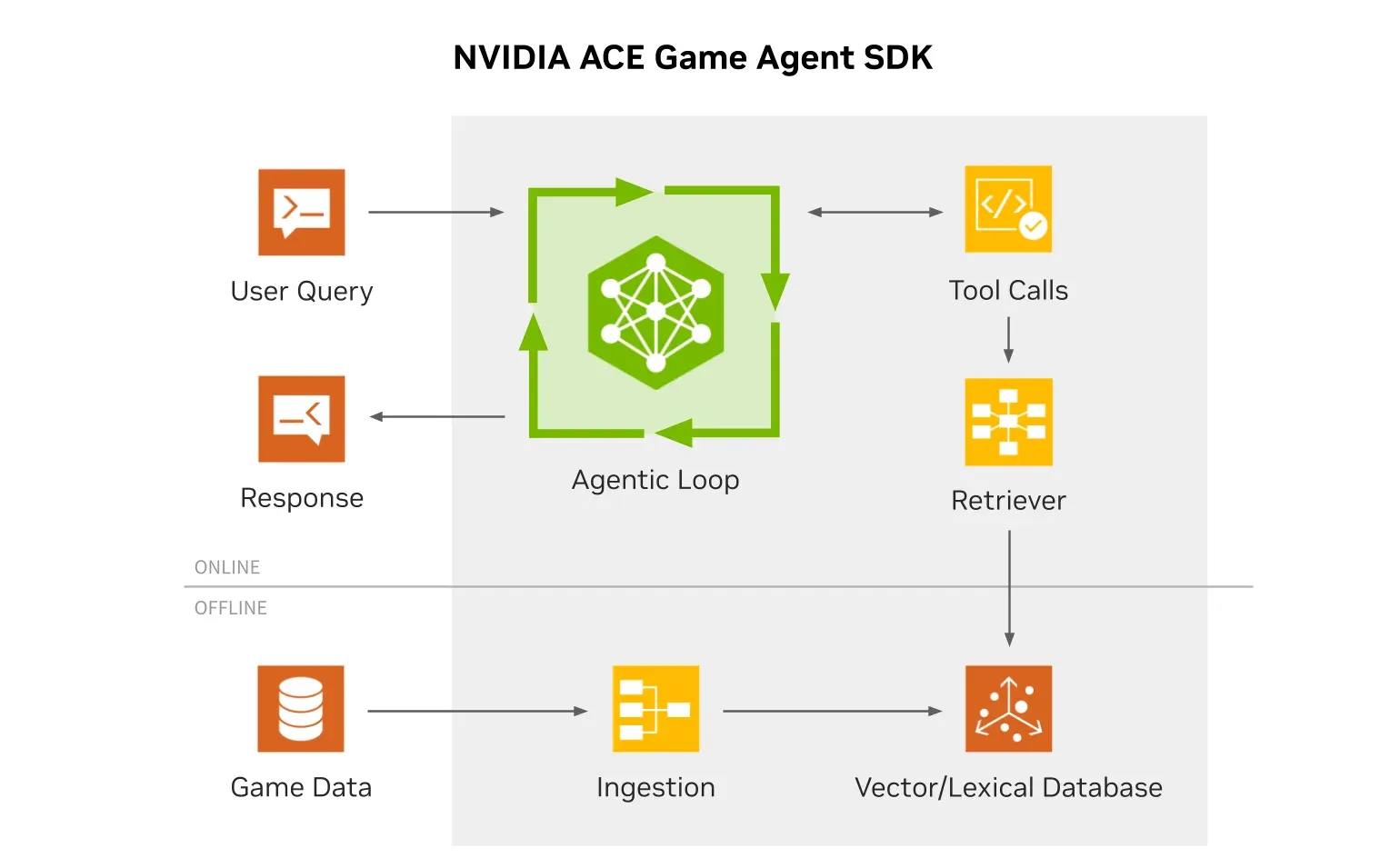
Figure: NVIDIA’s ACE Game Agent SDK exposes Agent, Chat, and RAG layers for native game integration. Source: NVIDIA.
The Unreal plugins provide an end-to-end voice loop
NVIDIA’s new Unreal Engine 5 plugins cover three runtime stages:
- Automatic speech recognition: A ready-to-use English ASR model plus additional language downloads turns player speech into text.
- Small language model inference: Local GGUF support enables low-latency text generation and function calling. NVIDIA includes a Qwen 3.5 4B configuration as a starting point.
- Text-to-speech: A Chatterbox Turbo 350M model produces voiced responses inside the local pipeline.
The plugins support Blueprint and C++ integration. Developers can connect transcription, dialogue, voice commands, and contextual actions to existing game logic instead of operating a separate AI service beside the engine.
Keeping the loop on the player’s RTX hardware can reduce network delay and make operating cost more predictable. It also avoids sending every microphone input or private conversation to an external API.
Local execution introduces a different constraint: the game must reserve enough GPU memory and compute for the model while continuing to render at an acceptable frame rate. A technically successful NPC is still a failed feature if inference causes stutter during combat.
PUBG Ally is the clearest companion example
KRAFTON’s PUBG Ally uses an on-device small language model built with NVIDIA ACE. The company says the co-playable character can understand voice instructions, discuss strategy, bring requested items, help revive teammates, and make decisions during looting, combat, and survival.
The key claim is action grounding. A companion that only talks is a chatbot in a game skin. PUBG Ally is intended to connect language to actual game commands and react to changing match state.
KRAFTON has also said the model understands PUBG terminology, maps, and item attributes and supports English, Korean, and Chinese. NVIDIA’s June update said an open beta was coming soon, but a permanent full-scale release should not be assumed until KRAFTON confirms it.
Total War uses RAG instead of a general chatbot
Creative Assembly’s experimental advisor for Total War: PHARAOH demonstrates a narrower design. The in-game pharaoh can answer strategy questions and recommend actions by retrieving information from more than 1,200 linked game-data tables.
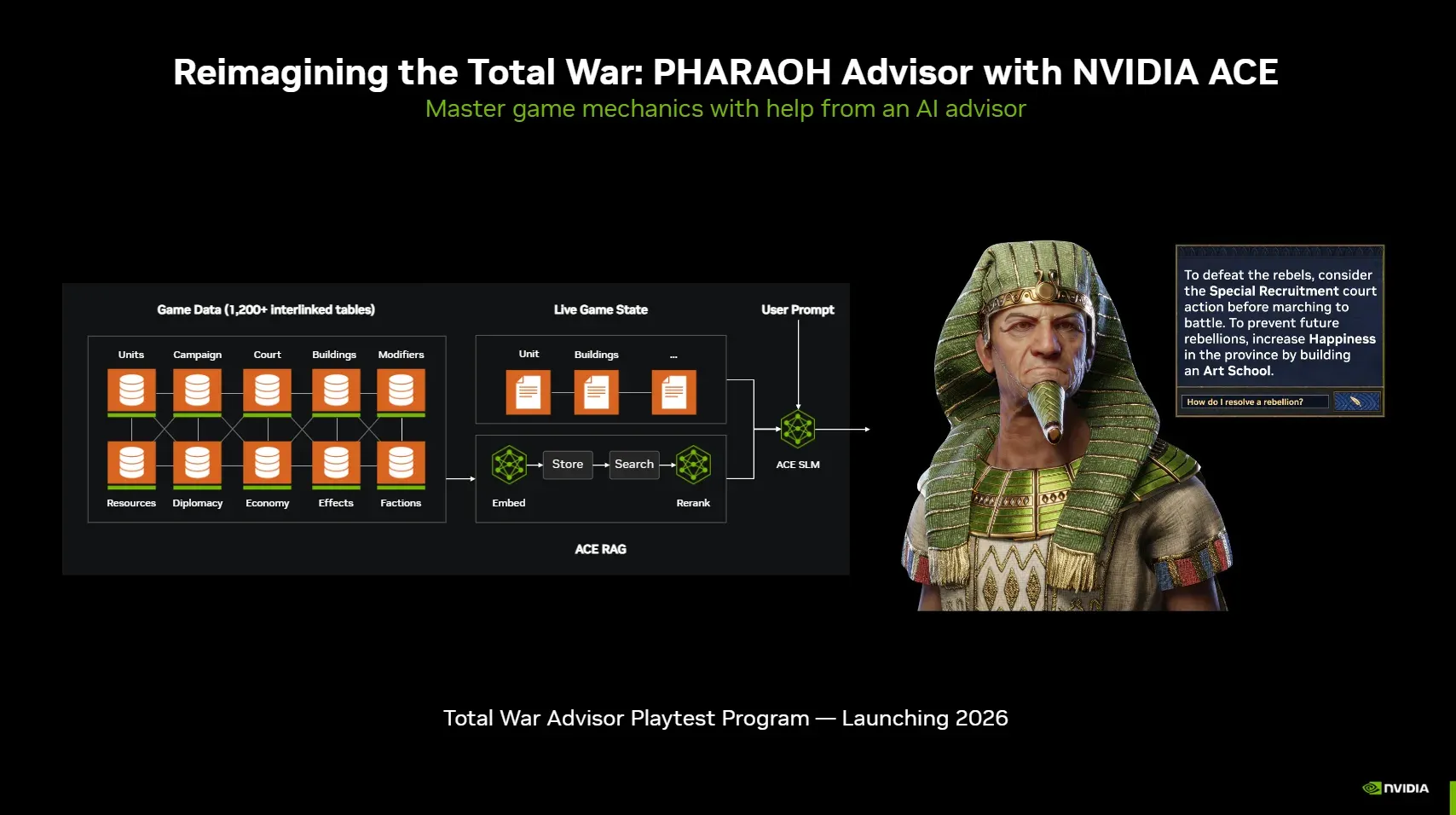
Figure: The experimental Total War advisor retrieves current strategy information from structured game data before responding. Source: NVIDIA.
That is a better fit for a complex strategy game than asking a general model to remember every unit, building, court action, and campaign rule from training data. Retrieval can ground the answer in the installed game version and current state.
The remaining challenge is evaluation. A fluent answer can still recommend a weak move. Developers need tests that compare advice against legal actions, known strategies, resource constraints, and the player’s actual campaign state.
On-device does not automatically mean reliable
Moving inference from the cloud to a GPU addresses cost, privacy, and latency, but it does not solve the behavioral problems of AI NPCs.
A production character still needs controls for:
- Invalid or impossible actions.
- Prompt injection through player speech or user-generated content.
- Repetitive dialogue and personality drift.
- Toxic or age-inappropriate responses.
- Infinite planning loops.
- Conflicts between generated actions and scripted missions.
- Save-game compatibility after a model update.
- Performance across different GPU tiers.
The most robust architecture treats the model as a planner that proposes actions through a narrow tool interface. Deterministic game code validates permissions, checks state, applies cooldowns, and decides whether the action can occur.
Inference economics may decide which NPCs become intelligent
Cloud AI creates a recurring cost every time a player speaks to a character. That cost is difficult to predict for a game expected to run for years. It can also encourage developers to sell conversation credits or limit how often the feature is available.
On-device models shift much of that expense to hardware already owned by the player. This can support longer sessions and offline play, but it fragments the experience by GPU capability. Studios may need fallback behavior for consoles, non-RTX PCs, or machines that cannot reserve enough memory.
The likely outcome is a tiered design. Important companions may use richer reasoning, minor NPCs may use smaller models or authored dialogue, and deterministic systems will continue controlling combat and quest state.
The signal
NVIDIA ACE is significant because it makes the surrounding infrastructure concrete. AI NPCs need more than a language model. They need speech, retrieval, memory, tool calls, engine bindings, animation, safety policies, and performance controls.
The release does not prove that open-ended characters are automatically more fun. It gives Unreal developers a more credible way to test that question inside a real game loop and on hardware with measurable latency and cost.