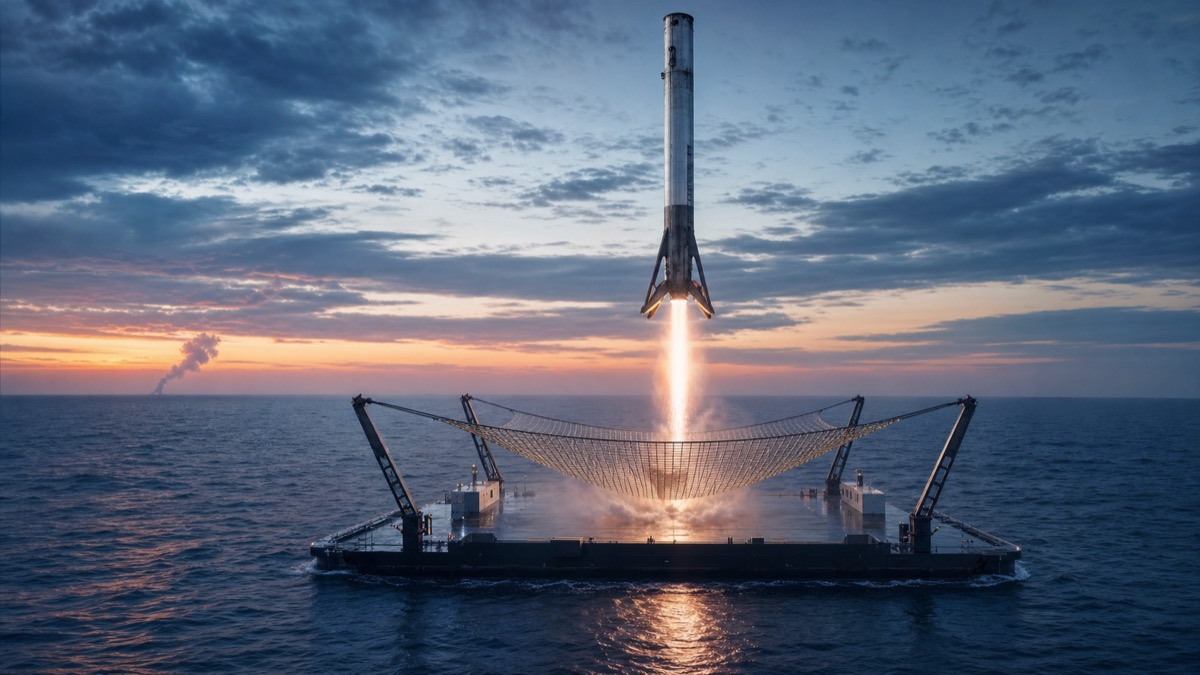
China has completed its first controlled recovery of an orbital rocket stage. The Long March 10B reached its target orbit on its maiden flight, while the first stage returned vertically and was captured by a net system on a platform at sea.
The July 10 mission is also described by Chinese state sources as the first net-based recovery of a launch vehicle. The distinction matters: the booster did not land on conventional legs or get caught by tower arms. A large maritime structure absorbed and supported the descending stage.
This was not only a landing test. The rocket carried a payload to its preset orbit, making the recovery part of an operational orbital mission.
What happened during the flight
The Long March 10B launched from Wenchang in Hainan. After stage separation, the first stage reversed its trajectory, controlled its descent, and approached the recovery ship vertically.
According to the mission account cited by Space.com, the stage reached the sea platform about six minutes after separation. The net-capture system received the booster while the upper stage continued the orbital mission.
China Aerospace Science and Technology Corporation has said it plans to fly the recovered stage again by the end of 2026. A successful second flight would be more economically meaningful than the recovery alone because reuse requires inspection, refurbishment, and reliable relaunch.
Why use a net?
Landing legs add mass, mechanisms, and aerodynamic complexity to the rocket. A recovery system placed on the ship can move some of that hardware off the vehicle.
A net may also provide a wider, more forgiving capture surface than a small rigid deck. It can deform under load and distribute force across the supporting structure.
The tradeoffs are substantial:
- The booster must still arrive with precise position and low vertical speed.
- Sea motion, wind, and waves move the target during final approach.
- The net and support arms must handle heat, exhaust, and dynamic loads.
- The stage can swing or contact surrounding hardware after capture.
- Recovery hardware on the ship becomes larger and more specialized.
The system does not eliminate precision landing. It changes the final mechanical interface.
The Long March 10B’s role
The Long March 10B is a two-stage vehicle about 63 meters tall. Reporting based on contractor information gives it a reusable low-Earth-orbit payload capacity of roughly 16 metric tons.
Its first stage uses kerosene and liquid oxygen, while the second stage uses liquid methane and liquid oxygen. That mixed-propellant architecture is unusual but separates the proven high-thrust booster role from a modern methalox upper stage.
The 10B belongs to the broader Long March 10 development family. The larger Long March 10 is part of China’s plan for a crewed lunar landing around 2030, while reusable variants can serve high-cadence low-Earth-orbit missions.
That makes the recovery technology relevant beyond one demonstration. Guidance, thermal protection, engine restart, structural margins, and refurbishment data can influence multiple vehicles in the family.
Recovery is not yet routine reuse
SpaceX’s operational advantage did not come from landing one Falcon 9 booster. It came from repeating recovery hundreds of times, reducing inspection work, increasing flight count per stage, and maintaining mission reliability.
Long March 10B now enters that longer test.
The next questions are:
- How much damage did the recovered stage sustain?
- Which components must be replaced before another flight?
- How long will inspection and refurbishment take?
- Can the net system operate in a useful range of sea conditions?
- Does reuse preserve the advertised payload capacity and reliability?
- How many flights can one stage complete?
Until those data exist, launch-cost claims remain projections.
China’s reusable launch field is getting crowded
The state program is not working alone. Several Chinese commercial companies are developing reusable orbital rockets, including LandSpace’s Zhuque-3, CAS Space’s Kinetica-2, Galactic Energy’s Pallas-1, and Deep Blue Aerospace’s Nebula-1.
Earlier Chinese orbital-class landing attempts reached important flight milestones but did not complete recovery. The Long March 10B mission changes the competitive baseline: a controlled orbital-stage recovery is now demonstrated rather than planned.
That can accelerate the domestic market for engines, avionics, reusable structures, recovery ships, and high-cadence launch operations.
The broader technology signal
Reusable launch systems are infrastructure for every space-intensive industry: communications constellations, Earth observation, navigation, in-orbit computing, and eventually large-scale science or lunar logistics.
The strategic value of this mission is therefore not the visual spectacle of a rocket meeting a net. It is the possibility of another launch ecosystem learning to recover, inspect, and refly orbital hardware at scale.
One recovery proves a capability. Repeated flights will determine whether it changes economics.