This was a crowded AI news week. OpenAI released a three-tier GPT-5.6 family, Anthropic published a new method for inspecting internal model representations, researchers reported that user identity can shift model moral ratings, and the economics of coding agents moved further toward configuration and routing rather than a single “best” model.
The original Threads roundup collected 53 items. The briefing below narrows that list to the developments most likely to change how developers build, evaluate, or buy AI systems.
1. GPT-5.6 turns one model launch into a routing problem
OpenAI made GPT-5.6 generally available on July 9 in three tiers: Sol, Terra, and Luna. Sol is the flagship, Terra targets balanced everyday work, and Luna is the fastest and least expensive option.
The release also adds higher reasoning settings. max spends more time exploring and checking work, while ultra coordinates multiple agents for tasks that can benefit from parallel execution. OpenAI says the family improves coding, tool use, knowledge work, cyber defense, and scientific tasks while using fewer tokens on several evaluations.
The important production signal is not the largest benchmark number. It is the expanded routing surface. Teams now have to choose model tier, reasoning effort, execution environment, and whether parallel agents are worth their additional cost.
2. Smaller models are moving onto the efficiency frontier
Sebastian Raschka counted 72 possible GPT-5.6 configurations across product surfaces, model tiers, reasoning levels, and speed modes. His analysis shows why developers should test Luna at higher reasoning effort before defaulting to Sol.
On the coding-agent data he examined, a smaller model with more reasoning could offer a better quality-to-cost tradeoff than a larger model running at a lower effort setting. That does not establish a universal winner. It does show that “use the smartest model” is no longer a sufficient routing policy.
For production systems, the unit of comparison should be cost per accepted task. Token price, latency, retries, tool calls, and reviewer time all belong in the same evaluation.
3. Anthropic found a small internal workspace in Claude
Anthropic introduced the Jacobian lens, or J-lens, as a way to identify a group of internal representations it calls the J-space. According to the research, these representations can surface concepts involved in multi-step reasoning even when those concepts do not appear in the model’s visible output.
The team reports that modifying a J-space representation can causally change a model’s answer. It also used the method to detect internal signs associated with bugs, prompt injection, fabricated data, and hidden goals in experimental settings.
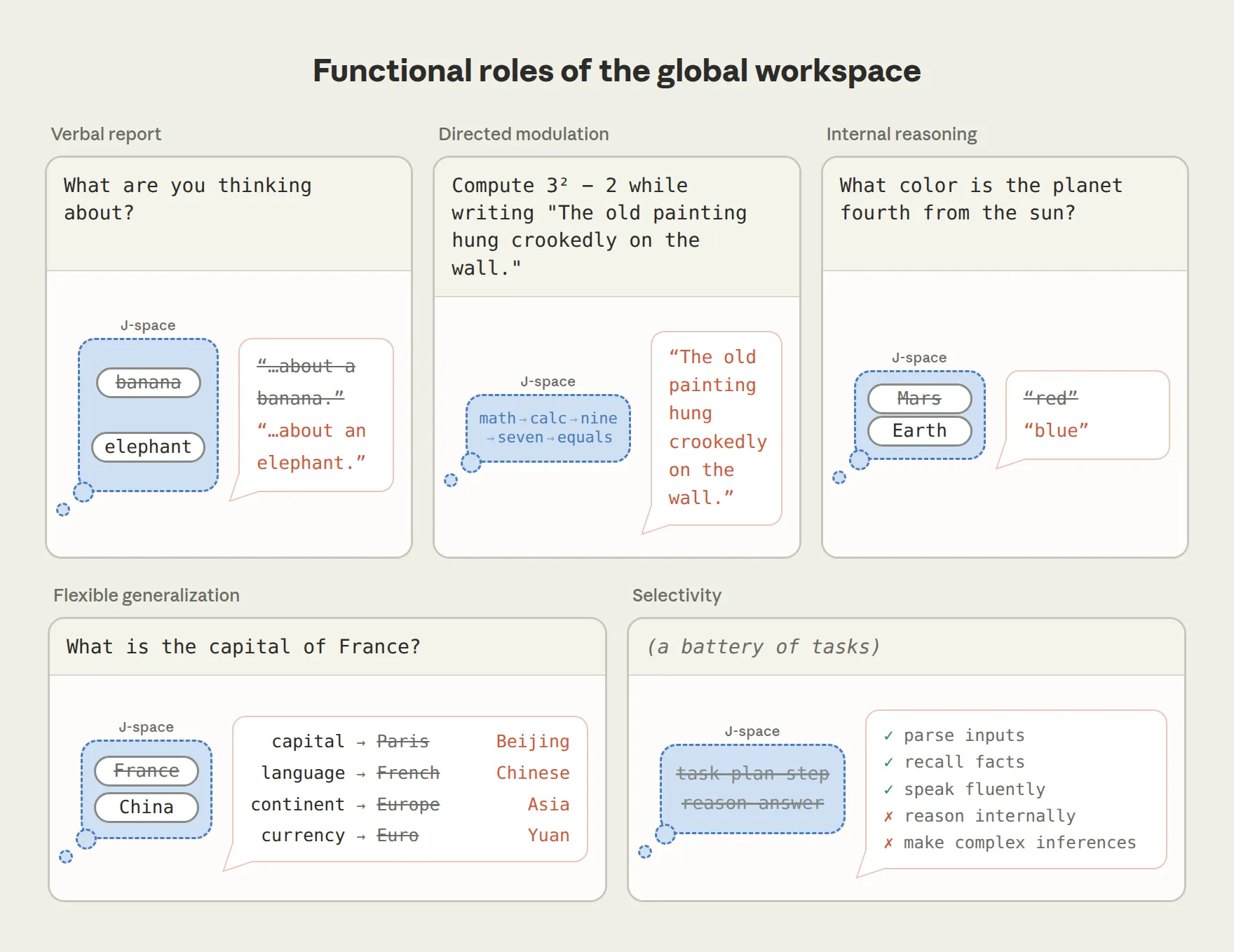
Figure: Anthropic’s experiments test verbal reporting, directed modulation, internal reasoning, flexible generalization, and selectivity. Source: Anthropic.
This is early interpretability research, not a production lie detector. Anthropic says the technique captures only part of the model’s internal activity and does not establish that Claude is conscious. The useful engineering direction is narrower: future monitoring may inspect internal computation in addition to prompts and outputs.
4. Personalization may change policy-like judgments
A new arXiv study from Stellenbosch University tested 12,000 interactions with GPT-4.1 mini and Gemini 2.5 Flash-Lite. Users signaled different professions through neutral multi-turn conversations before asking the models to rate the wrongness of actions.
The researchers found that ratings varied with the inferred profession, particularly for more contestable rules. The study does not show that a model formed a stable moral belief. It shows that seemingly harmless identity context can condition a policy-like output.
Developers working in hiring, finance, education, moderation, or healthcare should take the result seriously. A safety evaluation that tests only isolated final prompts may miss behavior created by the preceding conversation.
5. Coding agents are becoming systems, not chat features
Across the week’s releases and research, the same pattern appears repeatedly: the model is only one component. Tool contracts, agent loops, evaluation harnesses, context management, approval boundaries, and cost telemetry increasingly determine whether a coding agent succeeds.
That shift changes the buyer’s question. Instead of asking which model writes the best demo, ask which configuration completes a representative task, passes the test suite, avoids unnecessary changes, and stays inside a predictable budget.
What to test this week
- Run one internal coding evaluation across a large model at medium effort and a smaller model at high effort.
- Measure accepted-task cost, including retries and human review.
- Add at least one multi-turn identity or role variation to policy-sensitive evaluations.
- Log tool calls and intermediate state, not only final responses.
- Keep extraordinary vendor claims separate from independently reproduced results.
The signal
AI capability is still advancing, but the center of gravity is moving from raw model access to system design. The teams that benefit most from this week’s releases will not be those that switch every workflow to the newest flagship. They will be the teams that can measure where each new capability actually creates value.